

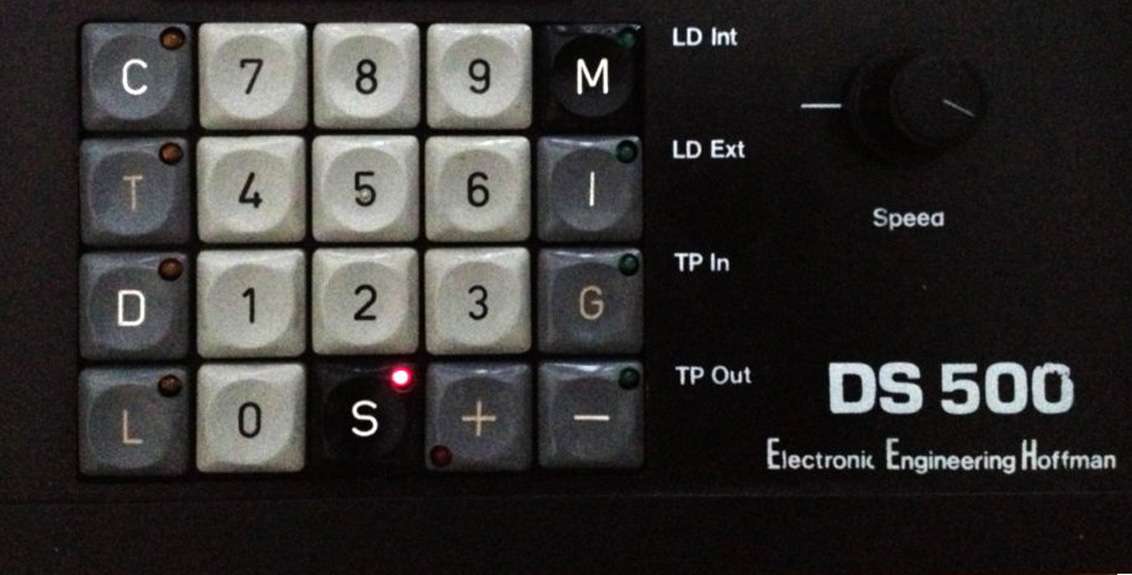

This is a possible project to recreate a very rare and unusual early digital sequencer the EEH DS 500. Only a handful were manufactured in 1981/82 in Germany and used by Tangerine Dream and Klaus Schulze, rather briefly as they quickly adopted MIDI sequencers in 1983.
I came across the sequencer in May 2020 and the web pages by Till Kooper here, which has bote the schematics and a German user manual. I have translated and improved the user manual into English and its here.
EEH DS 500 Operations Manual (English)
Looking at the schematics and after locating the OS EPROM binary I realised I could recreate the DS 500 completely. Whilst the sequencer is hard to program and has only 500 notes, it does have loops within loops, and makes an interesting project during the 2020 Covid-19 lockdown.
Technology Whilst the technology used in the DS 500 is 40 years old, the IC’s are still available at a low cost expect the DAC and unusual SN4929 combined NAND and Inverter CMOS chip, which are harder to locate and more expensive.
- NEC D780C (Z80 microprocessor) £4.50
- Intel 2716 EPROM (2KB)
- Two NEC D444C SRAM 450ns £7.00
- Intel P8225A £3.50
- Ferranti ZN426E DAC £20+
- 74LS48 and 74LS145 £3 each
- SN4929N
- CMOS 4016, 4030, 4011 , low cost
- LM324 replace with low drift OP2277 Op Amps
- DL304 7-segment displays £7.50
Switches & Buttons The original Rafi PPG style switches and buttons are no longer manufactured. The closest match is from Marquardt and the 6425 series of momentary switches. These have 16mm square caps in different colors, lettering and with space for a LED. After lots of research I gave up on finding every numeric key cap (7 was not in stock) and went with the correct light grey, dark grey and black cap colours with a red start/stop button. I will label the numerics and button descriptions onto the front panel.
Here is the BOM:
- 2x Switch Body Red LED – 6425.4111
- 4x Switch Body Yellow LED – 6425.4121
- 4x Switch Body Green LED – 6425.4131
- 10x Switch Body no LED – 6425.1101
- 2x Red button with LED – 826.000.071
- 8x Dark Grey button with LED – 826.000.021
- 10x Light Grey buttons without LED – 826.000.031

Project Status PCB design stage as at 16 May 2020.
EEH CM4 This is a much more powerful digital sequencer that was used by Tangerine Dream in the Poland concerts, with 4-tracks and 16 steps. Five units were made around 1983. The CM4 lives in an 8U 19″ rack panel and has the following features:
- 4x CV and Gate Outputs
- Clock in and out
- Clock divider switch
- MIDI out
- 40 memories (+ panel memory)
- Patterns can be linked to songs.
- Per track: display, end of sequence programming (reset value), note / pause ratio.
- Quantization of notes.
- Per step: potentiometer for programming the CV/gate values, switch with LED for switching the gates on and off.

It was based on the same Z80 technology used in the DS 500, but with more RAM (6 KB) and additional displays and front panel key pad controls. A couple of 16-way multiplexers and two 8225 Programmable Peripheral Interface chips are needed for all the I/O. A different DAC was used maybe a Burr Brown PCM54. The connections are at the base of the front panel, where you can see the CV and Gate outputs as well as MIDI, which presumably is just MIDI clock out, maybe clock in.
The usual PPG style Rafi push button switches with inbuilt LED’s are visible throughout, a total of 32. Unfortunately the CM4 must have been just as difficult to programme via a numeric key pad as the DS 500 and soon obsoleted by MIDI computers and sequencers. Tangerine Dream sold their two, probably in 1984, and as least one still exists today.
Information and images courtesy of Mirko Luethge August 2002 and Carsten Werner 2005.


TD still had at least one EEH-CM4 in 1986 as it can be seen in Chris Franke’s equipment rack during their UK/European tour
In the early 80s, I bought an EEH DS 500 for my Minimoog from the Matten & Wichers synthesizer studio in Bonn.
It was a brilliant device for its time, but programming it was only for technically minded musicians.
I made step lists on graph paper and often started over again. Typing quickly became chaotic, especially when it came to jump addresses and loops within loops.
Like many devices at the time, it had a cassette interface for saving sequences. These interfaces were often a pure gamble.